顯示具有 Wealth Inequality 標籤的文章。 顯示所有文章

2026年7月4日 星期六

The Landlord-Socialist: A Masterclass in Political Alchemy


The Landlord-Socialist: A Masterclass in Political Alchemy

In the grand tradition of political survival, few maneuvers are as breathtaking as the "Landlord-Socialist." It is the art of standing on a podium, condemning the parasitic nature of the landlord class, while simultaneously counting the rent checks from a London flat partially funded by the taxpayer. Andy Burnham’s journey from public servant to private landlord is not just a personal financial story; it is a clinical demonstration of the modern political psyche.

When he was a Member of Parliament, the taxpayer helped him purchase a property, cover his stamp duty, and renovate his living space. When the rules tightened in 2009, he didn't sell the asset; he simply pivoted. He kept the flat, rented it out, and then turned to the same taxpayers to cover his rent for a different apartment nearby. It is a seamless, beautiful cycle of extraction.

This is where the "socialist ideal of 斗地主" (landlord struggle sessions) meets the cold reality of human nature. In history, the struggle session was a zero-sum game: you stripped the landlord of his land to empower the collective. But in the modern Western context, the "struggle" has been sanitized into a brand. It is an aesthetic of grievance. The socialist politician doesn't need to actually eliminate the landlord class; he only needs to perform the resentment of them, all while ensuring his own portfolio is safely diversified into the very asset class he publicly loathes.

There is a dark, cynical humor in this. The instinct to accumulate resources is the oldest drive in our genetic code. We are hardwired to secure our own "nest" first, even as we lecture others on the virtues of altruism. The politician understands this better than anyone. He knows that the public craves a hero who fights for the "common man," and he knows that the common man is usually too busy trying to pay his own rent to notice that his representative is collecting it.

We aren't witnessing hypocrisy so much as we are witnessing the triumph of the status drive. The system allows for it, the laws protect it, and the politician is simply responding to the incentives. If you are angry at the landlord-socialist, you have misunderstood the game. He isn't failing to be a socialist; he is succeeding at being a human. And as history teaches us, the most effective way to protect your own wealth is to convince the masses that you are the only one fighting for theirs.


2026年6月6日 星期六

The Two-Tiered Fiscal Reality: A Cycle of Extraction vs. A Structure of Preservation


The Two-Tiered Fiscal Reality: A Cycle of Extraction vs. A Structure of Preservation

The narrative of modern taxation is often framed as a "civic duty," a fair contribution to the functioning of the state. However, when you deconstruct the lifecycle of wealth, a stark, two-tier reality emerges. For the average earner, the tax system acts as a cycle of extraction—a series of unavoidable tolls taken at every turn. For the wealthy, the tax system acts as a structure of preservation—a strategic framework for asset protection and growth.

The Cycle of Extraction (The Salary Earner’s Experience)

For the wage earner, there is no escape. The system is designed for "Pay As You Earn" (PAYE), meaning the government collects its share before the money even hits your bank account.

  • Earn: Income tax (up to 45%) and National Insurance are deducted immediately.

  • Spend: What remains is taxed again via VAT (20%) on consumption and various duties on fuel and services.

  • Save/Invest: Even modest growth on savings is taxed, and capital gains are levied at rates that feel punitive for those trying to build middle-class wealth.

  • Exit: Finally, death triggers Inheritance Tax, capturing a significant portion of a lifetime of work.

    The earner is a passive participant; the taxes are forced, automatic, and front-loaded.

The Structure of Preservation (The Corporate/Wealthy Strategy)

The wealthy do not "earn" in the traditional sense; they operate through entities. By shifting income into a Limited Company, the paradigm shifts from personal tax to corporate efficiency.

  • Corporate Shielding: Revenue flows into a company. Expenses—ranging from equipment to business travel—are deducted before profit is calculated, lowering the Corporation Tax burden.

  • Efficient Extraction: Instead of a high-rate salary, the wealthy take dividends (at significantly lower rates) or utilize capital gains, which are often taxed more favorably than income.

  • Tax Deferral: Assets are sheltered in trusts or compounded within pension schemes, allowing the "pot" to grow without the immediate friction of annual taxation.

  • The Rulebook Advantage: The wealthy aren't necessarily breaking rules; they are using the rulebook as a financial architecture. They view the tax code as a map of incentives and exemptions, whereas the average earner views it as a list of obligations.

The tragedy is not that tax exists; it is that the system treats the "labor of the many" and the "capital of the few" as two entirely different species of economic activity. One is taxed to sustain the system; the other is structured to minimize its impact.


2026年6月4日 星期四

The Coming Great Unraveling: Why the Next Decade Will Be a Financial Graveyard


The Coming Great Unraveling: Why the Next Decade Will Be a Financial Graveyard

We are currently drifting toward a cliff, and most people are too busy looking at their phones to notice the ground disappearing. We have spent the last decade fueled by cheap credit, status anxiety, and the delusion that "the economy" will always provide. But the math of the next ten years is not kind. We are about to witness a massive explosion of individuals reaching their sunset years with absolutely nothing to show for it.

The reality of human nature is that we prioritize immediate gratification over long-term survival. We have built a culture where saving is considered "depriving yourself," and debt is just "a lifestyle choice." When the music stops—and it is starting to stutter—the sheer scale of the unprepared will be unprecedented. We are looking at a demographic time bomb where a significant portion of the population will find themselves destitute, lacking both the capital to sustain their lives and the family structures that once provided a safety net.

This won't be a dignified exit. It will be a brutal confrontation with the darker side of our modern experiment. When your financial plan relies on "something working out," and you reach sixty-five with no assets and no liquidity, your choices become chillingly narrow. You are left with two options: either become an absolute burden on an already strained government apparatus, or beg for mercy at the doors of whatever charity still has the resources to look your way.

The state is not a limitless fountain of benevolence; it is a bureaucracy that is slowly suffocating under its own weight. When the wave of the destitute hits, the social contract will buckle. We are essentially watching a slow-motion car crash where the passengers have collectively decided that braking is for cowards. The next decade will not be defined by who got rich, but by the desperate struggle of those who realized, far too late, that the “system” never actually promised to take care of them at the end.


2026年5月31日 星期日

The Modern Serf: Why Your "Flexibility" is a Corporate Dividend


The Modern Serf: Why Your "Flexibility" is a Corporate Dividend

The gig economy was sold to us as the ultimate liberation. We were told we would be "our own bosses," "entrepreneurs of the self," liberated from the grey cubicles and the crushing boredom of the 9-to-5 grind. But look closely at the fine print of 5.5 million UK workers, and you’ll realize we haven’t entered a new age of entrepreneurial freedom; we’ve merely rebranded the 19th-century day laborer for the smartphone era.

In this brave new world, the platform is the master, and the worker is the commodity. By refusing to classify these millions as "employees," companies like Uber, Deliveroo, and Amazon Flex have orchestrated one of the most brilliant fiscal heists in history. They pocket over £3 billion a year in savings by simply offloading the inconvenient costs of civilization—sick pay, holiday pay, pensions, and redundancy rights—directly onto the shoulders of the people doing the actual work.

This is a masterclass in risk-shifting. In a normal business model, the company carries the risk of market fluctuations. In the gig economy, the worker bears 100% of the risk while the platform retains 100% of the scalability. If there’s a recession? The platform stays lean, and the workers go hungry. If a car breaks down? The platform’s algorithm just sends a new driver, and the previous one disappears into the void of the "independent contractor" status.

History has seen this play before. It echoes the sharecropping models of the past, where the landholder controlled the output while the laborer lived on the razor’s edge of survival. We have just replaced the dusty field with a digital app. It’s the darker side of human nature on full display: the drive to maximize efficiency by stripping away the dignity of the laborer, all while using the language of "empowerment" to keep them quiet. The platforms aren't businesses; they are digital toll-takers that have successfully convinced the peasantry that paying the toll is a lifestyle choice.


2026年5月6日 星期三

The Silver Scavenger: Navigating the Autumn of the Primate


The Silver Scavenger: Navigating the Autumn of the Primate

In the biological arc of the human animal, there is a peculiar period where the hunter-gatherer stops hunting but continues to consume. In the modern UK, we call this "retirement." Historically, the elderly were supported by the strength of the tribe, their wisdom traded for the vitality of the young. Today, that social contract has been replaced by a complex, fragile scavenger hunt across five different financial streams. The median UK retiree pulls in £21,500 a year, a sum that keeps them just inches above the "minimum" standard of living. It is a life lived on the edge of a cliff, where the State Pension provides a staggering 56% of the safety net.

From an evolutionary perspective, the "alpha" retirees—the top 10%—are those who successfully hoarded multiple sources of "stored energy": a Defined Benefit pension, a private pot, and perhaps a rental property (the modern equivalent of owning a fertile patch of land). But for the vast majority, the reality is a desperate patchwork. Nearly 30% are still performing "part-time work," a cynical euphemism for the fact that the primate cannot yet afford to stop climbing the tree. We’ve built a system that prizes individual accumulation, yet we’ve made the cost of territory (housing) and warmth (energy) so high that the average retiree is essentially a biological machine running on low-power mode.

The darker side of our nature is our "Future Discounting." We are wired to care about the meal in front of us, not the winter thirty years away. The state counts on this. By providing a pension that barely covers a "moderate" lifestyle, it ensures that the elderly remain a quiet, compliant class, too focused on the rising price of biscuits to revolt. If you are aged 30 to 50 now, the lesson is cold: the "tribe" is not coming to save you. By 2050, the State Pension will be a pittance. Unless you are building your own private granary of ISAs and pensions now, your "golden years" will be less about dignity and more about the art of survival in a landscape where the fruit is high and the strength is gone.


The Great Sorting Hat: Why Your Boss is a Different Species


The Great Sorting Hat: Why Your Boss is a Different Species

In the biological theater of the modern UK, we like to pretend that all "full-time workers" belong to the same tribe. We wear similar suits, drink the same overpriced coffee, and commute on the same decaying trains. But look at the ONS data for 2026, and the illusion shatters. A finance worker earning £58,000 and a retail worker surviving on £24,000 are not just in different tax brackets; they are effectively living in different ecosystems.

From an evolutionary perspective, humans have always specialized. In the past, the hunter and the gatherer shared the spoils of the kill because their survival was interdependent. Today, that link is broken. We have created a high-status "priest class" of finance and tech workers who manage digital abstractions, and a "servant class" of retail and hospitality workers who handle physical reality. The biological effort—the stress, the hours, the exhaustion—is often identical, or even higher for those at the bottom. Yet, the financial "meat" is distributed with a 2.4x disparity.

The darker side of human nature is our obsession with hierarchy and our incredible capacity for "Industry Snobbery." We justify these gaps by whispering myths about "value creation" and "complex skill sets." In reality, the industry you choose is often a matter of geographical luck or early-life sorting. If you are born in London, you are 23% likely to be pushed into the finance stream. If you are in Hull, you are 14% likely to end up in retail. It is a modern form of serfdom where the "industry" acts as the new feudal manor.

History shows us that whenever a society creates such a vast gap between those who produce essential services (food, health, education) and those who shuffle paper, the system becomes fragile. We pay the person who teaches our children £35,000, while the person moving digital spreadsheets earns £58,000. It is a cynical business model that prizes the "abstract" over the "actual." If you find yourself in a low-paying industry, the lesson is cold but clear: the tribe doesn't reward hard work; it rewards being in the right room. Evolution favors the adaptable—sometimes the best career move isn't working harder, but jumping to a different ecosystem entirely.


2026年4月24日 星期五

The Three Altars of Wealth: A Taxonomy of the Chinese "Naked Ape"


The Three Altars of Wealth: A Taxonomy of the Chinese "Naked Ape"

If we examine the "Hurun" or "Forbes" China rich lists over the past decade, we see a frantic, high-stakes game of musical chairs. While the official narrative celebrates "entrepreneurial spirit," applying the cynical lens of power dynamics reveals a much more primal structure. Using the three-tier classification of wealth—those who print, those who divide, and those who borrow—we can see how China’s billionaires aren't just business leaders; they are biological opportunists navigating a hyper-artificial habitat.

The First Category (Privilege to Print) belongs to the invisible elite—the "Red Aristocracy" or the quiet controllers of state monopolies. You won't find most of them on public lists because real power is allergic to sunlight. These are the interests behind the energy, telecommunications, and financial sectors. In the evolutionary jungle, they are the ones who own the weather. They don't need to compete; they simply define what "value" is.

The Second Category (Privilege to Distribute) is occupied by the "Platform Kings" of the last decade, like the early titans of tech and real estate. These moguls—think of the Jack Mas or Pony Mas at their peak—became rich by being granted the "license" to organize the digital and physical lives of 1.4 billion people. Their wealth was a byproduct of a state-sanctioned monopoly. They were allowed to "divide" the massive dividends of China’s growth, provided they kept the tribe orderly and the technology under watch.

The Third Category (Privilege to Borrow and Never Repay) is the most spectacular of all. This is the domain of the "Debt Magicians," epitomized by fallen giants like Xu Jiayin (Hui Ka Yan) of Evergrande. These men built empires of glass on mountains of "bad debt." By leveraging their connections to state banks, they borrowed hundreds of billions, funneled the cream off the top into private offshore trusts, and left the "tribe" (the homeowners and subcontractors) to deal with the collapse. They are the parasites that grew larger than the host.

In the end, the "dark side" of this wealth creation is the realization that in a system governed by "Superhuman Orders" (The Party/The State), wealth is never truly owned—it is only "on loan." Whether you are a tech visionary or a property mogul, if the tribe’s leader decides the hunt was illegal, your status as an "Apex Predator" vanishes overnight.


2026年4月14日 星期二

The Gravity of Greed: Why the Poor Stay Groundless

The Gravity of Greed: Why the Poor Stay Groundless

Wealth has its own gravitational pull. In physics, the more massive an object, the more it attracts everything around it. In the "market," this translates to a cynical reality: it is incredibly expensive to be poor, and almost effortless for the wealthy to stay rich.

The three advantages—Information, Resources, and Connections—are not just tools; they are the walls of a fortress. Consider Information. In the digital age, we are told data is democratic. It’s a lie. The elite don't just read the news; they influence the people who write it. By the time a "market trend" reaches the commoner’s smartphone, the cream has already been skimmed. This is the information asymmetry that turns the market into a casino where the house always knows the next card.

Then there is the Resource cushion. For the man with a single "錐" (awl/drill), one mistake means starvation. He cannot afford to be "disruptive" or "innovative" because failure is terminal. Meanwhile, the capital-heavy player can fail ten times, treat it as a "tax write-off," and strike gold on the eleventh. The system doesn't reward the hardest worker; it rewards the one who can survive the most mistakes.

Finally, Connections. This is the invisible plumbing of power. While the masses compete in a "meritocracy," the elite operate in a "proximity-ocracy." It’s not about what you know, but whose dinner party you attended. This is the darker side of human nature: we are tribal creatures who prefer a familiar face over a superior talent.

When these three forces combine, the "water pool" doesn't just flow; it creates a vortex that leaves the bottom bone-dry.


2026年4月8日 星期三

The Landlord's Last Laugh: Legacy in a Matchbox


The Landlord's Last Laugh: Legacy in a Matchbox

Real estate has ceased to be shelter; it has become the ultimate "Parental ATM," a delayed inheritance that defines destiny before a child even learns to walk. In the UK, the ghost of Margaret Thatcher still haunts the housing market. Her 1980 "Right to Buy" scheme was a masterclass in short-term political gain—sell off public assets to create a "property-owning democracy," but fail to build replacements. The result? A supply drought that turned modest family homes into speculative gold mines.

Today, the "Bank of Mum and Dad" is the only lender that matters. If your parents bought a house in the 80s for the price of a ham sandwich, you are royalty. If they didn't, you are a serf in a "matchbox." We are witnessing the shrinking of the human habitat; modern apartments are designed for a single soul and a depressed cat, yet they cost more than a 19th-century manor once did. This isn't progress; it’s a feudal system rebranded as "urban living." As the Baby Boomers eventually pass on their brick-and-mortar fortunes, the wealth gap won't just be a crack—it will be a canyon, separating the landed gentry from the permanent rent-paying underclass.


2026年3月13日 星期五

The Great Australian Heist: When "Public Service" Becomes a Private Club


The Great Australian Heist: When "Public Service" Becomes a Private Club

History teaches us that the closer you are to the printing press, the fatter your wallet becomes. Milton Friedman famously noted that the most inefficient way to spend money is spending "other people’s money on other people." But he missed a nuance: spending other people’s money on oneself is the pinnacle of bureaucratic evolution.

The latest Workplace Gender Equality Agency (WGEA) report in Australia was supposed to be a lecture on social justice—a way to shame the private sector into balancing the scales between men and women. Instead, it accidentally pulled back the curtain on a far more cynical reality: the Australian federal government has created a "Bureaucratic Aristocracy" that makes the private sector look like a charity ward.

Take the Clean Energy Finance Corporation (CEFC). Their lowest-paid 25% of staff earn an average of $137,000. To put that in perspective, that’s nearly double the national median income. In the halls of the CEFC, being "bottom of the barrel" puts you in the top 10% of the Australian workforce. And don’t even get me started on the Future Fund, where the top quartile earns an average of $560,000. That’s not a public service salary; that’s a "lottery winner" stipend, funded by the very taxpayers who earn five times less.

The excuse is always the same: "We have to pay market rates to attract talent from investment banks." Yet, history shows that when the state begins to mimic the excesses of the market without the market's risk of bankruptcy, you are no longer a government—you are a protected cartel. The Albanese government boasts of low unemployment, but they conveniently forget to mention that a huge chunk of that "growth" is just the public sector cannibalizing the treasury to hire more of their own.

When the Romans started paying the Praetorian Guard more than the legions, the Empire’s days were numbered. Today, we don’t have Praetorians; we have statutory authorities with 15.4% superannuation. It’s the ultimate business model: zero competition, infinite funding, and a workforce that gets paid more to regulate the economy than the people who actually build it.


2026年3月12日 星期四

The Meritocracy Trap: When the Reward for Hard Work is a 62% Tax Bill


The Meritocracy Trap: When the Reward for Hard Work is a 62% Tax Bill


In the traditional fairy tale of Western meritocracy, the deal was simple: study hard, get a professional job, and your rising salary would buy you a ticket to the "good life." But in modern Britain, the "ladder of success" has been rigged with a series of fiscal landmines. We are witnessing the death of the Meritocratic Dream, replaced by a system that punishes productivity and rewards stagnation.

The rise of the HENRYs (High Earner, Not Rich Yet) is the ultimate symptom of this decay. When doctors, headteachers, and senior police officers—the literal backbone of society—find themselves dragged into the 45% tax bracket not by "elite wealth," but by a cynical mechanism called Fiscal Drag, the social contract is broken. The government has frozen tax thresholds until 2031, effectively turning inflation into a silent, secret tax hike.

The most perverse element is the "£100k Tax Trap." Between £100,000 and £125,140, the withdrawal of the Personal Allowance creates a marginal tax rate of 62%. Add in the loss of childcare subsidies, and a professional getting a pay rise can actually end up poorer in real terms.

What is the natural human reaction to being punished for working harder? Strategic retreat. We are seeing a "collective lowering of controllable income." Professionals are choosing to work four days instead of five, or funneling every spare penny into pensions just to stay under the £100k ceiling. This is a disaster for national productivity. When your best surgeons and most experienced teachers decide that "doing more" isn't worth the cost, the entire public service infrastructure begins to crumble.

We are moving toward a "K-shaped society." On one arm, the truly wealthy live off inherited assets and capital gains (taxed at much lower rates). On the other arm, the professional middle class is squeezed until they lose the incentive to climb. In the end, the UK is no longer a high-income society; it is a high-tax, low-incentive trap where the only way to "win" is to stop trying so hard—or to stop being an employee and start being a corporation.


2025年6月20日 星期五

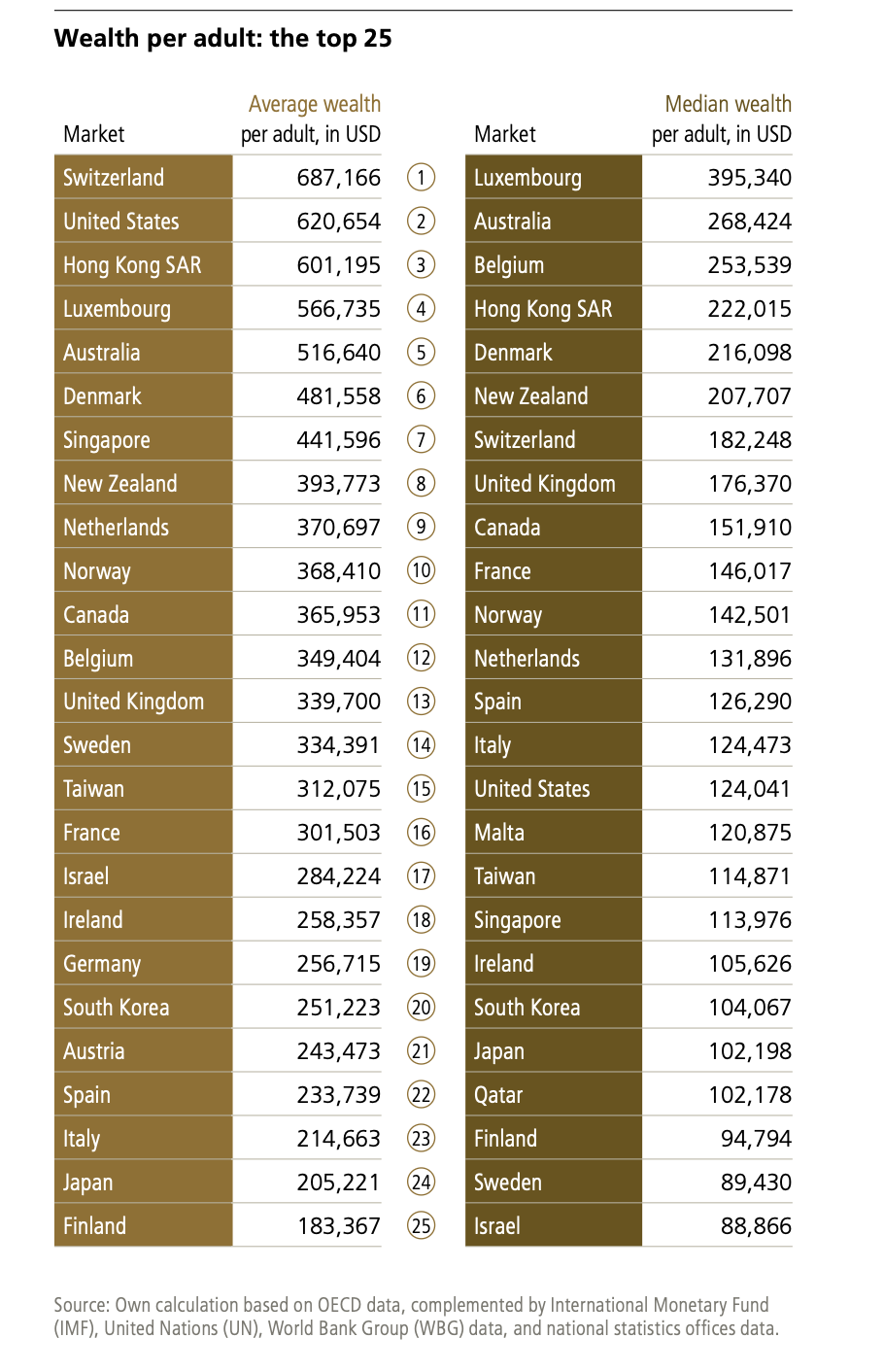
Wealth Disparity Unveiled: Decoding the Gap Between Average and Median Wealth


Wealth Disparity Unveiled: Decoding the Gap Between Average and Median Wealth

The provided data on wealth per adult across various countries below offers a fascinating glimpse into global economic landscapes, but a deeper dive into the figures reveals a critical dimension often overlooked: the disparity between average and median wealth. This gap is a powerful indicator of wealth distribution within a nation, highlighting countries where a small segment of the population holds a disproportionately large share of the wealth.

The Significance of the Gap: Average vs. Median

To understand the implications, it's essential to differentiate between average (mean) and median wealth:

  • Average Wealth: This is calculated by summing the total wealth of all individuals and dividing by the number of individuals. It can be heavily skewed by a few extremely wealthy individuals, pulling the average upwards even if most people have modest wealth.
  • Median Wealth: This represents the wealth of the person exactly in the middle of the wealth distribution. Half the population has more wealth than the median, and half has less. It is a more robust measure of "typical" wealth and is less affected by extreme outliers.

When the average wealth is significantly higher than the median wealth, it strongly suggests a highly unequal distribution of wealth. This indicates that a considerable portion of the total wealth is concentrated in the hands of a relatively small number of wealthy individuals, while the majority of the population holds much less. Conversely, a smaller gap between average and median wealth points to a more equitable distribution.

Countries with Striking Disparities

Analyzing the provided data, several countries stand out due to the substantial difference between their average and median wealth per adult:

  1. Switzerland: With an average wealth of $687,166 and a median of $182,248, Switzerland exhibits the largest absolute difference among the top countries. This significant gap suggests a highly concentrated wealth at the very top, even though the average wealth is globally unparalleled.
  2. United States: The US also shows a considerable disparity, with an average of $620,654 and a median of $124,041. This is a well-documented characteristic of the US economy, where wealth inequality has been a persistent concern.
  3. Hong Kong SAR: While both its average ($601,195) and median ($222,015) wealth are high, the difference is still substantial, indicating a significant concentration of wealth.
  4. Singapore: With an average of $441,596 and a median of $113,976, Singapore presents another case of a notable gap, pointing to a hierarchical wealth structure despite its overall economic prosperity.
  5. Denmark: The average wealth is $481,558, while the median is $216,098. While perhaps less extreme than some others, this still suggests a concentration of wealth.
  6. Australia: Average wealth stands at $516,640, with a median of $268,424. While the median is relatively high, the difference still signifies that the average is boosted by a wealthier segment.

Other notable examples include Norway (average $368,410 vs. median $142,501) and Canada (average $365,953 vs. median $151,910).

The Significance for Equality

The large discrepancy between average and median wealth has profound implications for social and economic equality:

  • Concentration of Power: When wealth is highly concentrated, it often translates into concentrated economic and political power. A small elite can disproportionately influence policies, regulations, and economic decisions, potentially to their own benefit rather than for broader societal welfare.
  • Reduced Social Mobility: Significant wealth inequality can create barriers to social mobility. Individuals from less wealthy backgrounds may face greater challenges in accessing quality education, healthcare, and opportunities, perpetuating cycles of disadvantage.
  • Social Unrest and Instability: Extreme wealth disparities can lead to social unrest and political instability. A sense of unfairness and exclusion among the majority can erode social cohesion and trust in institutions.
  • Slower Economic Growth: While some argue that wealth concentration can drive investment, excessive inequality can actually hinder long-term economic growth. It can reduce overall demand, limit human capital development, and stifle innovation by excluding a large segment of the population from full economic participation.
  • Erosion of Public Goods: When the wealthy accumulate vast sums, they may increasingly opt for private services (education, healthcare, security), potentially reducing their support for public goods and services that benefit everyone.

Countries with More Equitable Distributions

Conversely, countries where the average and median wealth are closer indicate a more even distribution. While the table primarily focuses on high-wealth nations, we can infer that countries with smaller gaps (or those not appearing in the top ranks for average wealth but still having a respectable median) are likely to exhibit greater equality in wealth distribution. For instance, Belgium ($349,404 average vs. $253,539 median) has a comparatively smaller gap among the listed wealthy nations. Similarly, while not at the top for average wealth, Spain has an average of $233,739 and a median of $126,290, suggesting a less extreme skew than some of the top-tier average wealth countries.

Conclusion

The divergence between average and median wealth serves as a crucial metric for assessing the state of wealth equality within nations. While high average wealth may indicate overall prosperity, a wide gap between the average and median points to significant disparities that can undermine social cohesion, limit economic opportunity, and potentially lead to societal instability. Policymakers and citizens alike should pay close attention to these figures, as they offer valuable insights into the true economic well-being and fairness of a society. Addressing these disparities through progressive taxation, robust social safety nets, investment in public services, and opportunities for all remains a critical challenge for many of the world's wealthiest nations.