The 19th-Century Clickbait: When Fake News Was Hand-Painted Propaganda
History is rarely a sterile archive of cold, objective facts; more often, it is a grand, comforting fairy tale manufactured by terrified humans who simply refuse to accept reality. Step back to 1895. The Qing Empire had just suffered a humiliating defeat in the First Sino-Japanese War, forced to hand over Taiwan and the Pescadores to Japan like a bankrupt gambler paying off a debt. Enter General Liu Yongfu, the rugged commander who dug in his heels to lead Taiwan’s short-lived Democratic Republic resistance. To a shell-shocked mainland public desperate for a shred of dignity, Liu became an instant folk hero. And what do humans do when reality is too grim to bear? They invent a better one.
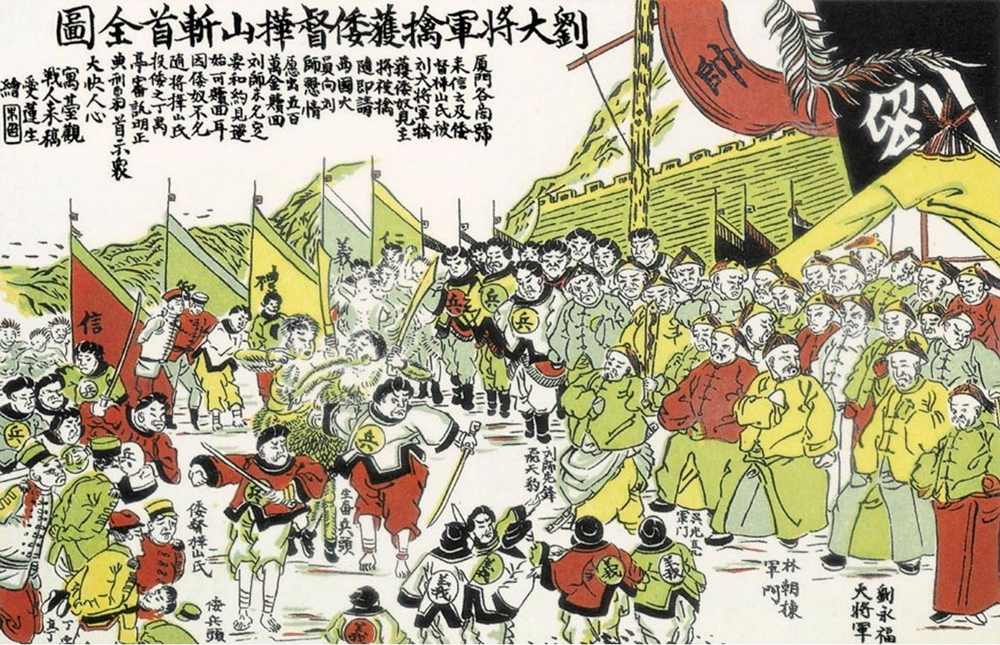
Enter the magnificent world of late-nineteenth-century mass media. Shanghai was the booming publishing hub of the era, churning out black-and-white pictorials and vibrant, color-saturated "news New Year prints." Among them was a masterpiece of wishful thinking: a dazzling illustration depicting General Liu Yongfu single-handedly capturing Japan's Taiwan Governor-General, Kabayama Sukenori, while decapitating him, flanked by enthusiastic indigenous allies joining the anti-Japanese crusade. It was thrilling, dramatic, and entirely, catastrophically fake.
Was it malicious disinformation? Not quite. It was something far more human: 19th-century clickbait born of collective desperation. Crushed by military defeat and weeping over indemnity payments, Chinese society craved a hero. When whispers drifted across the strait about Liu’s fierce resistance, Shanghai illustrators took loose rumors, mixed them with pure, unadulterated fantasy, and weaponized imagination to soothe an entire nation's bruised ego. These prints flowed back into Taiwan, creating a bizarre feedback loop where rumors birthed art, and art birthed national myths. Today, we would flag these prints with a stern community note warning of manipulated media. Back then, they were psychological armor—a collective coping mechanism wrapped in red and gold ink.
Human nature remains profoundly unchanged by our shiny new algorithms. Whether it is a viral panic on social media today or a hand-painted woodblock print in 1895, our evolutionary wiring hungers for narrative over truth. We don't want to hear that our side is losing; we want to see the villain beheaded by our champion, even if he is sitting safely in a Shanghai studio holding a paintbrush. The next time you roll your eyes at modern propaganda, remember that fake news didn't start with the internet—it started the moment humans discovered they could print their own delusions.


 發表文章
發表文章

